EV charging is now the most-asked-about topic in strata energy, and for good reason. The cars are everywhere, residents want to charge at home, and a wave of state legislation is making it harder for owners corporations to say no.
In NSW the rules are clear. Owners corporations can no longer block residential EV charger installations on the basis of aesthetics alone (heritage exceptions aside), and sustainability infrastructure resolutions now pass on a simple majority rather than a special resolution. In Victoria, all new apartment buildings have been required to be EV-Ready under the National Construction Code since May 2024.
For most existing buildings, the question has moved from “should we allow chargers?” to “how do we actually do this without breaking the building?” This article is about the second question.
The rules, in plain English
In NSW, EV charging infrastructure is classified as Sustainability Infrastructure under section 132B of the Strata Schemes Management Act. A sustainability infrastructure resolution now passes unless 50 per cent or more of votes cast are against it (a simple majority threshold rather than the previous special resolution requirement).
From 1 July 2025, owners corporations cannot ban an EV charger installation on aesthetic grounds unless the building is heritage listed. If a request is unreasonably refused, the lot owner can take the matter to the NSW Civil and Administrative Tribunal.
In Victoria, the National Construction Code 2022 requires every new apartment building to be EV-Ready, and the state government 2025 guidelines have streamlined the by-law process for installations in older buildings. State and federal grants are available in both jurisdictions to co-fund retrofits.
The technical question every committee should ask first
The single most important question in a strata EV rollout is not “what charger should we use?” It is “how much spare electrical capacity does the building actually have?”
Most apartment buildings were designed before EVs existed. The main switchboard, the riser, and the metering room have a fixed capacity. Adding a single charger usually fits within that capacity. Adding ten or fifty without coordination almost certainly does not.
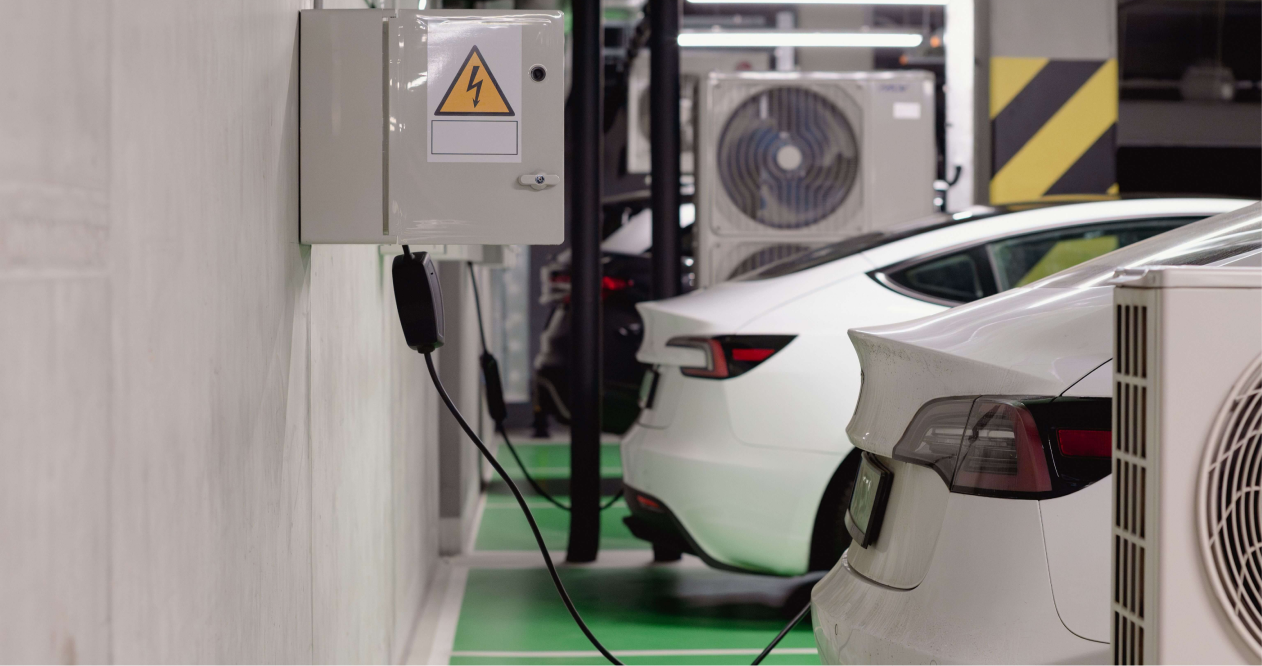
The fix is not bigger infrastructure. It is smarter infrastructure. Load management systems share available capacity dynamically across active chargers, so the building never trips its main supply even when every spot is in use. The right design lets a building start with a few chargers and scale to every car park over time without a network upgrade.
Five things a good rollout gets right
First, a strategic plan. Even if only one resident wants a charger today, the rollout should be designed for the building as a whole. That avoids costly rework later and avoids the situation where the first three chargers consume all the available capacity.
Second, separate metering and billing. Residents should pay for their own charging consumption directly, not have it bundled into common-area expenses. This avoids cross-subsidies and disputes.
Third, load management. As covered above, this is the single most important technical decision and the difference between a rollout that scales and one that stalls.
Fourth, clear by-laws and use rights. Common property installations need a by-law that covers ownership, maintenance, insurance and removal. A template by-law from a recent similar building is a good starting point.
Fifth, a funding plan. Costs can be funded by the lot owner, by the owners corporation, by a third-party operator under a service agreement, or by a combination. Each has trade-offs, and the right structure depends on the building.
Common pitfalls
The most common pitfall is also the easiest to avoid. Approving the first charger as a one-off, with no plan for the second or fiftieth, almost always creates capacity, billing or by-law problems later. Treat the first charger as the start of a portfolio, not a one-time decision.
The second pitfall is going to one installer for one quote. EV infrastructure is a fast-moving market and prices vary widely. A clear design brief and a tender across two or three providers is straightforward to run and usually pays for itself many times over.
The third is forgetting to consult residents. Even where the resolution thresholds are low, a rollout that has been workshopped with residents lands far better than one that arrives as a surprise on the AGM agenda.
How Strata Energy Services helps
Strata Energy Services helps owners corporations design EV charging rollouts that scale across the building, integrate with existing infrastructure, and survive the next ten years of resident demand. We are independent of any charger manufacturer or operator, so our recommendation is based on what works for the building, not on whose product is being sold.
If your committee is being asked to approve a charger, or several, visit strataenergyservices.com.au and we will walk you through what good looks like.
Sources
.png)